Unconference - an online learning approach in real world
Unconferences are spreading around the world and it proves that Internet communication behaviour, knowledge sharing approaches, and the open source philosophy transcend into real world. But what is unconference? Basically it is a get together of people who would like to exchange certain themes. Interested persons can join the two day discussion and brainstorming. One important rule: everybody is a listener and a presenter at the same time. The event is organized over a wiki. It can be practically organized by anybody.
 But what makes it so special and different? Some weeks ago, in April, I was lucky to join a barcamp, a form of unconference, here in Frankfurt. Robert Basic and Franz Patzig initiated it. In the following weeks the wiki gained life and people signed in as attendees, proposed topics in the realm of web2.0 and coordinated logistics and even a sponsor. Here are some interesting impressions that I got from barcamp Frankfurt:
- At the beginning, as there was not a fixed plan, everyone was curious waiting around for something to happen. After half an hour or so, two initiators explained the concept. This was followed by short but funny introductions of each one of the 150 attendees, who, most of them had very different backgrounds and worked in very different fields.
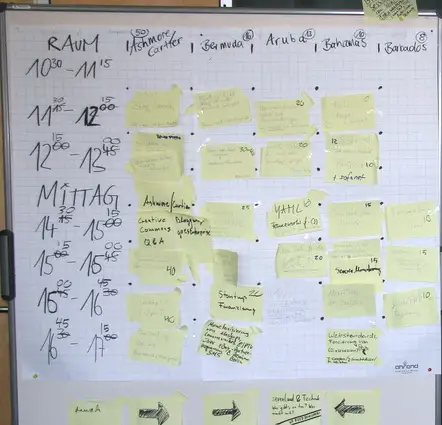
- After the little introduction, everybody crowded in front of the board (photo) to see the offered sessions and to add an extra one or join with another similar one. That was enough to start the various presentations. Some people did sophisticated power-point presentations for creative commons while others talked freely about knowledge management in enterprises. Discussions arose and new sessions developed out of them.
- The event offered an informal atmosphere with many open minded people. You could easily ask questions to each other and network. Small groups were formed spontaneously to discuss and to brainstorm. The common interest and open approach in how to address problems was very interesting.
To me, it seems that unconference is overlapping with open space, which is more of a method while behind unconference there is a philosophy. It is fascinating how unconference motivates people to network and collaborate. In that regard, it is quite different to conventional conferences because it is a bottom-up approach, highly creative and can be used for all sorts of topics. In Canada transit camp discusses local development, and in France a wine camp was organized. Some other examples are Kenya or India where Barcamps were also organized. Lastly, this fascinating initiative is explained in detail in a book, which is of course written as well in a wiki.