Twitter analysis: Development organizations and their listening skills

Apr / 27 / 2010

Everybody wants to be on Twitter and development organizations are no exception. But what do they really want to gain from Twitter? Do they really want to use Twitter to interact through a two-way conversation with their audience? I was curious, so I did a small analysis.
I have chosen ten Twitter accounts from well known development organizations to check their listening and interaction skills. I simply counted and analyzed their replies and retweets of the last 50 tweets. Unfortunatelly couldn’t find the time to check the amount of requests sent to the organizations. For sure, for a more representative analysis, more organizations and more indicators would be helpful. Volunteers are welcome!

However, the results are anyway quite clear: There is practicaly no interaction. Twitter is used by development organizations as a purely broadcast channel.

Most make great use of retweets, which are often from affiliated organizations such as in the case of the United Nations. So, even when they retweet, these organizations are still not necessarily following what happens in the twitterverse. Others use inflationationary hashtags such as UNDP. My favorite is: “Burkina Faso: Support for HIV-positive patients http://ow.ly/1BJ0I #HIV #AIDS #UNDP #UN #BURKINAFASO #AFRICA #ARVs” by UNDP.

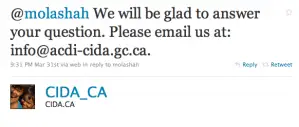
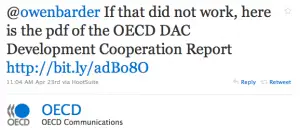
The only exception I could find was the OECD and CIDA, which actually responded to people.
So why do such organization use Twitter if they miss the opportunity to engage with their audience? Don’t they have sufficient resources or are not ready for an authentic conversation? Or, are only the people behind public relations responsible for the Twitter account?

In any case, the amount of followers says very little if an account is also influential and being heard. For example, check out accounts with huge followers and their retweet rate. Not rarely it is incredibly low. That’s why I checked some of the above Twitter accounts also on Twinfluence, which analysis Twitter accounts through different parameters from social network analysis. The results are complementary with the ones above. The United Nations account with 32.055 followers has an influence of 1%. Development Gateway has 4% and OECD 62%.

So, in conclusion, it looks as if development organizations are still on a journey to develop listening skills. But to be fair, there are more promising examples such as the World Bank’s involvement in their Facebook page.

Popularity: 75% [?]

Related posts:

  1. Talking with the audience: Development organisations and social media In addition to my recent Twitter analysis, I wrote another...

{ 54 comments… read them below or add one }

ABottiglieri May 19, 2010 at 9:12 pm

Twitter & development organizations, not always a match made in heaven http://tinyurl.com/2cyreuz

Linda (@meowtree) May 20, 2010 at 2:00 pm

Christian, as you mentioned “good point about many employees of organizations who are tweeting. Probably they should be included in a next analysis. I wonder how many employees are encouraged to tweet or communicate publicly by their management?”

I’d love to see an analysis on that – might be hard to find employees as many tweet anonymously for the very reason that the relationship with personal/organization hasn’t been totally worked out! Next week I’m actually attending a meeting at the organization where I work and I will have a few minutes to talk about blogging and twitter, etc. One goal I have is to raise this discussion, show that employees can also bring credibility to their organizations by tweeting/blogging individually, and in their own words, not promoting strict “organizational messages” or tweeting press releases or strictly news emanating from their organization, but really engaging with topics, themes and discussions.

We’re developing some policies around it as well, but not restrictive policies, more guidelines so that employees feel safe to engage via social media and have some guidance on how to do it. Another point is that by having people from different parts/sides of the organization using social media, you can focus in on or engage in the many different aspects of an organization’s work, eg., specific program areas (like water and sanitation, gender, logistics, ICT4D, etc.) communications, marketing, fundraising, advocacy, policy, etc. By breaking it down I think it can be more focused and more engaging; maybe keeping a ‘one-way organization account’ for giving out those branded, official messages, that then different employees can adapt and engage around if they fit the area or interest of that employee.

Carlos Rey Moreno May 20, 2010 at 2:08 pm

RT @ckreutz: No interaction! Twitter Analysis: Development organizations and their listening skills http://cxed.net/bv0W7a

DI program DK July 18, 2010 at 9:36 am

http://bit.ly/9RnHMB maybe its time to improve our comuinication skills? :)

Leave a Comment

Previous post:

Next post: