A shift in information sharing: Faster, more intensive and direct

Dec / 18 / 2009

Something has changed. Information sharing isn’t what it used to be. We are in a middle of a network transformation as information sharing becomes faster, more intensive and more interconnected. In terms of collaboration and innovation, it is exciting, but in terms of speed, we might reach our limits. Twitter is the gravitation center of these changes, showing us how things will develop further:

  • Speed: Sharing and interaction becomes amazingly fast through real-time web.
  • Intensity: An explosion in “fast food content” shared across networks.
  • Crisscrossed: Networks are not only growing exponentially in size, but also in their density.

Speed

Not so long ago, information sharing in open and loose networks used to take days. One could see how the news or an article was bookmarked in Delicious, bookmarked by other in the next days and sometimes developed to a larger wave until bloggers picked it up and a conversation emerged here and there. It was the start of the social web, which now seems to be outdated if one looks at the breathtaking speed of tweets. Whereas before some waves were drifting through the ocean – nowadays the sea is full of waves wandering across networks in minutes. Welcome to the real-time web. Want to know what is going on somewhere right now?
Have a look at Twitter search and you may find out because most probably, someone will be there. For certain requests this search is excellent. Even Google has acknowledged it recently and started to include tweets into its search. The Internet turns into a central nerve system.
I have asked how people share and search information nowadays through Twitter and these are some of the interesting feedbacks I have got, most related to speed: (Thanks for sharing!)
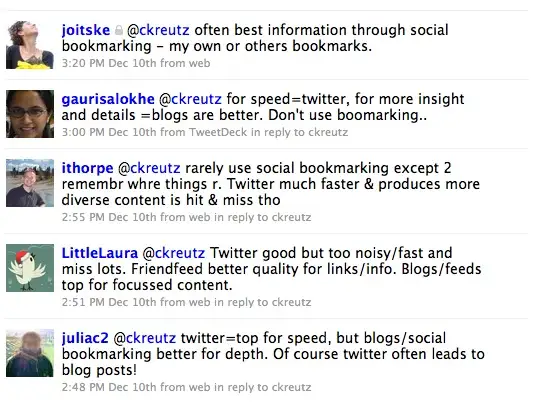
On a scale from 1-5 how much quicker/ better information you get through tools such as Twitter, Friendfeed vs. blogs or social bookmarking?

On a scale from 1-5 how much quicker/ better information you get through tools such as Twitter, Friendfeed vs. blogs or social bookmarking?

Intensity

Amit Agarwal has an interesting comparison on how people used to share information and how drastically it has changed. Whereas in 2008 email was still leading with over 30%, it is now bypassed by Facebook for sharing links with nearly 30%. In second place come emails with 13,8% and then Twitter with 11%. It shows how information sharing across networks becomes a truly mainstream activity. But it seems as if sharing was being dominated by short content or “fast food content,” as Michael Arrington calls it. He mainly talks of aggregated content but also discusses “the end of hand crafted content.” The ‘read/write’ web offers an explosion in content creation and micro-blogging; as Twitter seems to the right channel for sharing information.

Crisscrossed

From my observations, the explosion in network connectivity is the most fascinating one. The exponential growth of networks can be counted everywhere, but more fascinating is the growing density within networks. Particularly on Twitter with its low barriers for connections and openness, new connections are being built easily and interaction is a core piece behind it. This can really bring people, expertise and ideas together. One such example is the ICT4D field. Two years ago there were more or less loosely linked communities  around the Internet. Now you can tap into a community within a short time through searching social networks a la Facebook or Twitter. I wish there was a study on what this new density of interaction and many links between people bring, in terms of collaboration and innovation.

Related posts:

  1. When do we trust an information source? Information research is performed in many different ways throughout...
  2. Cairo, Johannesburg, Mumbai – 24 hrs Google Buzz and location-based information pops up everywhere In this blog post, I will dive into the...

{ 13 comments… read them below or add one }

marcopolis Dec / 19 / 2009 at 3:47 am

RT @VenessaMiemis: A shift in information sharing: Faster, more intensive and direct http://bit.ly/5ow8HA via @participatory

The Social CMO Dec / 19 / 2009 at 3:54 am

RT @VenessaMiemis A shift in information sharing: Faster, more intensive and direct http://bit.ly/5ow8HA via @participatory

ideahive Dec / 19 / 2009 at 4:55 am

RT @VenessaMiemis: A shift in information sharing: Faster, more intensive and direct http://bit.ly/5ow8HA via @participatory

janine cahill Dec / 19 / 2009 at 4:57 am

RT @ideahive: RT @VenessaMiemis: shift in information sharing: Faster, more intensive & direct http://bit.ly/5ow8HA via @participatory >>GR8

janine cahill Dec / 19 / 2009 at 4:59 am

love this blog. thnks @ckreutz http://bit.ly/5n4R4x >>gr8 report

Openworld Dec / 19 / 2009 at 5:46 am

A fourth bullet point should be included – accelerated trust-building.

Trust grows as one has the means to know the character of a person, rather a single facet. In the past, trust could expand through email exchanges, web searching, and diving deeply into their blogs. Now it can be done far faster. Twitter’s brevity lets you see fast what the other person values, how they engage with others, and how those values converge with yours. Each person’s Tweet streams trace the outlines of a whole person. A transparent community that offers vast opportunities for reputation-building relationships helps to bring out the good qualities in all.

Best,

Mark Frazier
Openworld.com
@openworld (twitter)

Wim Rampen Dec / 19 / 2009 at 6:18 am

RT @ideahive: RT @VenessaMiemis: A shift in information sharing: Faster, more intensive and direct http://bit.ly/5ow8HA via @participatory

Sabine Dufaux Dec / 19 / 2009 at 8:22 am

RT @ideahive : A shift in information sharing: Faster, more intensive and direct http://bit.ly/5ow8HA (via @participatory @VenessaMiemis)

florin flueras Dec / 19 / 2009 at 11:48 am

RT @VenessaMiemis: A shift in information sharing: Faster, more intensive and direct http://bit.ly/5ow8HA via @participatory

David J Carr Dec / 19 / 2009 at 11:48 am

RT @sdufaux: RT @ideahive : A shift in information sharing: Faster, more intensive and direct http://bit.ly/5ow8HA (via @VenessaMiemis)

Bijan Kafi Dec / 19 / 2009 at 12:19 pm

I don’t quite follow what you mean by “more intensive” as a characteristic of the new media environment. Maybe a definition would be useful? From my perspective, what happens is the exact opposite, if we understand “intensity” in the sense of “complexity” and that also seems to be what you mean in the rest of the article. Or do you mean the discussions are getting less diverse, or broad? In that case I’d also disagree, I think. Or are you simply referring to more people sharing in the first place?

Christian Kreutz Dec / 19 / 2009 at 12:42 pm

@openworld great point. Indeed the issue of trust is really important and also changing. Do you think we gain more trust, because more conversations are happening online? That reminds of the still valuable concept of “virtual identity”. In the past an identity shaped mostly around smaller or closed communities, whereas nowadays one creates a more public online identity with quite some consequences.

@Bijan you got me there. I struggled with this exact term, but was not sure how to name it differently. :-) I believe there is an “explosion” in communication. Not only more people are joining the conversation, but the level of interactivity is growing. Whereas in the past you could answer many posts in mailing lists or forums, still that is incomparable with the intense interaction we are now witnessing in many more ways through different options such as comments, tagging, rating, replying, forwarding etc. Imagine that kind of interaction would still go over email. The real-time web makes it possible that conversation can pop up each time you engage or not. Before you needed to hang around in a Internet Relay Chat and your audience was very limited. So by intensity I am talking about three dimensions: We interact a lot more online, we communicate from anywhere (mobile phones) and we absorb a lot more tiny fractions of content. Hope that makes it clearer. Thanks for critically question it!

Mark Frazier Dec / 19 / 2009 at 2:50 pm

.@ckreutz Thx for reply on the #trust-building innovations in social web breakout http://is.gd/5tMZo #socent

Leave a Comment

Previous post:

Next post: