What if you were in Ethiopia, walking by a school, directing your mobile’s camera to towards it and suddenly you get all the information available about the school, such as the development projects involved with it, the amount invested to build it, and the school’s drop out rate.
How transparent is development aid?
Is it only sciene-fiction? Welcome to augmented reality and the plans to use open data in the future. Owen Barder talked about the exact same idea in a recent podcast at the Center for Global Development. Of course, it is questionable whether concrete information stream is instantly needed; it might easily overwhelm us, but certainly this kind of transparency might have a huge impact on development aid.
Most people agree that the development aid world needs more transparency. It is not easy or almost impossible to get an overview of what really happens in a country or a sector. Senegal alone has 82 individual aid co-ordination forums, but that has not brought the transparency needed, and made it even more complicated, as Owen Barder writes in his thoughtful and provoking post: “The coming collapse of the development system”. A transparent overview on all activities, partnerships and financial involvements, could bring light in this unnecessary complexity.
Small first movers in the development aid world
Many organizations and some governments have started opening up their repositories of data to be accessed publicly, such is the example of the development sector, where first organizations have freed their data. The World Bank has an API to access data, and the UK Department for International Development (DFID) has a new way to present its project data. Whereas the former offers statistical data, such as development indicators, the latter publishes project information to be monitored. But come on … is that all?
Initiatives to use open data
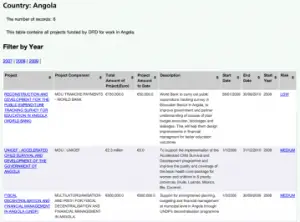
Such open data could be used by external initiatives or watchdogs. A good example for development in Africa is the Ujima project, which shows project data from USAid and DFID. Unfortunately, the majority of organizations seem to be only discussing the move to open data, but until now, they rather enclose information. To be fair, many development organizations have a huge challenge – they have various different databases, formats and struggle to get them better connected as well. One example is the challenge around Management Information System.
No related posts.

This blog explores worldwide social innovations and information and communication technologies. 
{ 30 comments… read them below or add one }
RT @ckreutz: blogged about the long journey to transparency and open data in the development aid sector http://cxed.net/df2nSt
RT @ckreutz Blog about about the long journey to transparency and open data in the development aid sector http://cxed.net/df2nSt
The long journey to transparency and open data in the development …: A good example for development in Africa is… http://bit.ly/aRRjGq
crisscrossed – The long journey to transparency and open data in the development aid sector http://bit.ly/91Rku4
RT @ckreutz: blogged about the long journey to transparency and open data in the development aid sector http://cxed.net/df2nSt
Christian, is there any reason why you didn’t mention the IATI initiative, a fairly high-profile post-Accra venture with quite a few big wigs in the boat? (http://aidtransparency.net/) You also didn’t mention “Publish what you Fund” (http://www.publishwhatyoufund.org/), a long-runner in the game.
I’ll allow myself to invite you to our Xing group we just started on the matter. It’s early, but we’d be happy to see a discussion going on there, too.
Recently, I participated in a discussion on this in the Netherlands (http://www.openroadmap.net/index.php?title=Workshop_8_April_2010_Programme), where a lot of these initiatives was mentioned. Same challenge however : databases don’t match, the data that can be exchanged is (left aside a couple of exceptions) limited to data at project level. To share other data (results of baseline data, monitoring data) we need to think also about the structure of data, probabbly some meta-data format, with a combination of variable and value , enriched with tags on period of time, point of interest, modus (planning, estimation, measurement) and source. Not sure yet whether you should store data in this format, or just invite all open data providers to offer an API using it, because flexible reporting with metadata as a source is a challenge in itself.
RT @ckreutz The long journey to transparency and open data in the development aid sector http://cxed.net/df2nSt
The long journey to transparency and open data in the development aid sector http://bit.ly/dh8JOw
RT @ckreutz: blogged about the long journey to transparency and open data in the development aid sector http://cxed.net/df2nSt
RT @ckreutz: blogged about the long journey to transparency and open data in the development aid sector http://cxed.net/df2nSt #resrap20
RT @ckreutz: blogged about the long journey to transparency and open data in the development aid sector http://cxed.net/df2nSt
Hi Christian,
great article again, I visited the same meeting as Tom (above here) and the issue is hot in the Netherlands but also in international donor world. I will approach you through other means to discuss this further, I will put some energy in this subject as well.
Are you still in Mexico?
Cheers,
Hapee
great piece on a complecated subject: The long journey to transparency and open data in the development aid sector http://ow.ly/1yHMq
@ckreutz on transparency and open data in development and aid: http://bit.ly/c7NzYQ (We've also got a post coming soon.)
Rt @hapeeg The long journey to transparency and open data in the development aid sector http://ow.ly/1yHMq
RT @hapeeg The long journey to transparency and open data in the development aid sector http://ow.ly/1yHMq (via @Info_Activism)
RT @hapeeg: The long journey to transparency and open data in the development aid sector http://ow.ly/1yHMq
RT @Info_Activism Rt @hapeeg On transparency and open data in the development aid sector http://ow.ly/1yHMq #development #technology
RT @Info_Activism: Rt @hapeeg The long journey to transparency and open data in the development aid sector http://ow.ly/1yHMq
The long journey to transparency and open data in the development aid sector http://u.nu/3c5f8 #OS20
Info is good. But info alone /= policy change. RT @arjencito: transparency and open data in the development aid sector http://u.nu/3c5f8
RT @GlobalIntegrity: Info is good. But info alone /= policy change. RT @arjencito: transparency and open data in the development aid sector http://u.nu/3c5f8
RT @arjencito: The long journey to transparency and open data in the development aid sector http://u.nu/3c5f8 #OS20
RT @GlobalIntegrity: Info is good. But info alone /= policy change. RT @arjencito: transparency and open data in the development aid sector http://u.nu/3c5f8
RT @ckreutz: blogged about the long journey to transparency and open data in the development aid sector http://cxed.net/df2nSt
RT @GlobalIntegrity Info is good. But info alone /= policy change. RT @arjencito: transparency & open data in dev aid http://u.nu/3c5f8
RT @arjencito: The long journey to transparency and open data in the development aid sector http://u.nu/3c5f8 #OS20 #resrap
@worldaidunited Check eens het verhaal op http://ow.ly/32oSc. Past goed bij waar we mee bezig zijn.